
Learning Japanese Naturally Through Everyday Life
It is hard to keep learning a foreign language. I think one common reason is that after learning the very basics, people do not know what to do next. When learning the Japanese syllabary, enthusiasm may be strong. After that, things become confusing. Memorizing vocabulary often leads to forgetting it. Practicing common phrases over and over only leaves you with a few sentences.
The method I now want to use is to start from real problems. I do not need to understand everything perfectly at first. I want to grasp the general idea and use it.
Everyday Shopping
For example: これはいくらですか。
In real shopping situations, this sentence is not very useful. Prices are usually displayed clearly. Even if you ask and the staff tells you, they may then explain the product, and you may not know how to respond.
A more practical sentence is something like: お米はどこですか。
If someone tells you where the rice is and how to get there, you already have the basic idea: go forward, turn left, turn right, next to something, and so on. That makes it easier to understand what the Japanese speaker says. After you find it, you can respond with simple polite phrases you already know.
If you accumulate many simple but successful exchanges like this, I think the effect can be surprisingly good.
At first, I found that although I had memorized some simple words, when the teacher or Japanese people in daily life said them at normal speed, I could not react immediately. Now I gradually feel that when Japanese people say those words naturally, I can recognize them much faster.
A Sign in the Park
公園利用者のみなさんへ
公園の中で犬の散歩させる人は、フンの後始末を、して下さい。
又公園内では、犬を放さないで下さい。
(長いリードはご遠慮ください。)
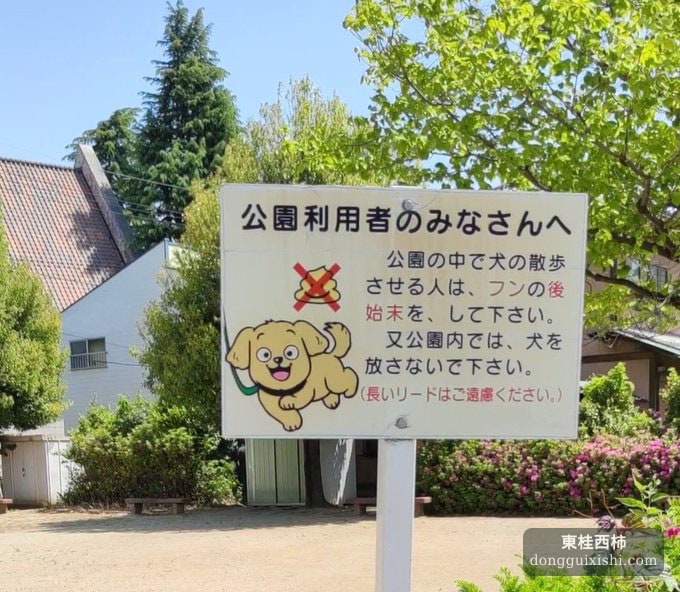
The sign roughly means: if you walk your dog in the park, please clean up after it. Also, keep your dog on a leash and do not let it run around freely with a long leash.
Even if you do not know Japanese, you can understand the meaning from the sign. For learning Japanese, you can pay attention to:
- の, へ, 中, 内, で
- ください
We had just learned location words such as above, below, front, back, and next to. I think learning from Japanese you encounter in everyday life, where you already understand the situation, works well.
Personally, I learn better from something I already understand than from something completely unknown. That does not mean familiar things are not worth studying.
Traffic Signs
Japanese has only non-past and past tense, but the many conjugations can still make your head spin. They are hard to remember and hard to use quickly.
I now accept my own situation and do not force myself to memorize everything actively. Instead, I slowly get used to things that appear frequently around me. For example, this traffic sign says: 自転車を除く, meaning bicycles are excluded from the restriction.
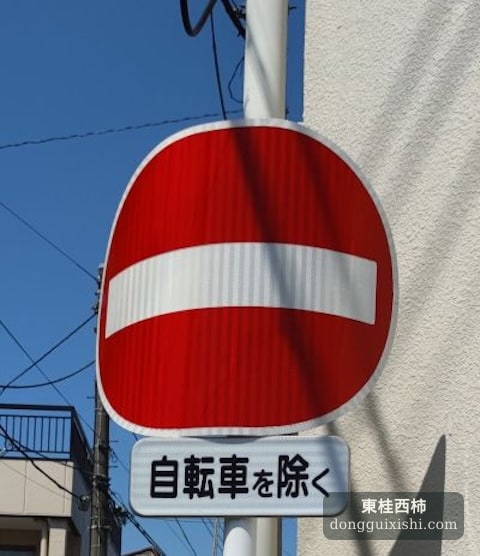
This phrase is noun + particle + verb.
We can immediately sense that 除く must be a verb form worth checking. The first time you do not know it, look it up and you will find its masu-form is 除きます. Once you connect it with the real situation, it becomes easy to remember. If you see it often while walking around every day, it gradually sticks without much effort.
In Japan, bicycles are somewhere between the Chinese idea of a motor vehicle and a non-motor vehicle. To simplify, you can treat them more like vehicles. On roads without sidewalks, ride on the left. If there is a sidewalk, bicycle lanes are usually marked.
Daily Food and Drink
We had already learned i-adjectives and na-adjectives. I-adjectives can connect directly to nouns, while na-adjectives need な before nouns.
How do we tell them apart? I found that words ending in い are often i-adjectives, while na-adjectives are often easier to recognize in kanji. But be careful: some words are confusing when written in hiragana, such as きれい.
Here is an example from everyday life. On this Meiji milk carton, it says: おいしい牛乳 新鮮な生乳のおいしさ、そのまま。
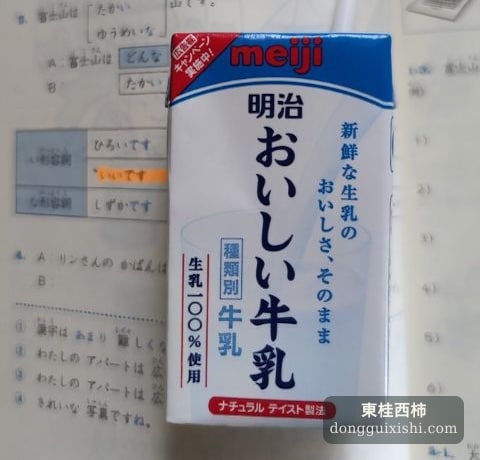
The meaning is roughly: delicious milk, with the freshness of raw milk kept as it is. The feeling is a little like a catchy advertising line.
Inside the sentence, you can see both i-adjective and na-adjective usage: おいしい and 新鮮な. If you drink it from time to time, it becomes hard not to remember.