
A Memory Method for Japanese Verb Conjugations
Japanese words have many conjugations. For verbs alone, the basic forms include:
- Dictionary form, nai-form, ta-form
- Masu-form, te-form
- Potential, passive, causative, imperative
- Prohibitive, conditional, volitional
My Memory Method
With so many forms, how should we remember them? My method is:
- First distinguish plain form and polite form.
Verb plain forms include dictionary form, which is non-past affirmative; nai-form, which is non-past negative; and ta-form, which is past affirmative.
Verb polite forms include masu-form and honorific form, which is the same shape as passive form in many cases. - Te-form and ta-form follow the same conjugation pattern.
- Some forms can be conjugated again like dictionary form.
Potential, passive, and causative forms all end in る, so they can again become nai-form, ta-form, masu-form, te-form, and so on.
For Group 2 verbs, the potential and passive forms are the same. - Imperative form.
Group 1 verbs do not take an extra suffix in the same way. - Some forms have special endings and should not be conjugated further in the same way.
These include prohibitive, conditional, and volitional forms, which I arrange in あいうえお order for memory.
Forms That Are Hard to Remember
The following are still not easy for beginners. I still do not remember all of them perfectly.
Potential: e-row, る, られる, できる
Passive: a-row, れる, られる
Causative: a-row, せる, させる
Imperative: e-row, ろ, い
Prohibitive: u-row, な, るな
Conditional: e-row, ば, れば
Volitional: o-row, う, よう
Special Group 2 Verbs
Japanese verbs are divided into Group 1, Group 2, and Group 3. Different groups follow different conjugation rules.
Group 1 verbs are relatively easy to identify, but their conjugations are the most complicated. For Group 2 verbs, there are some special cases that should be memorized separately. I made a table for reference.
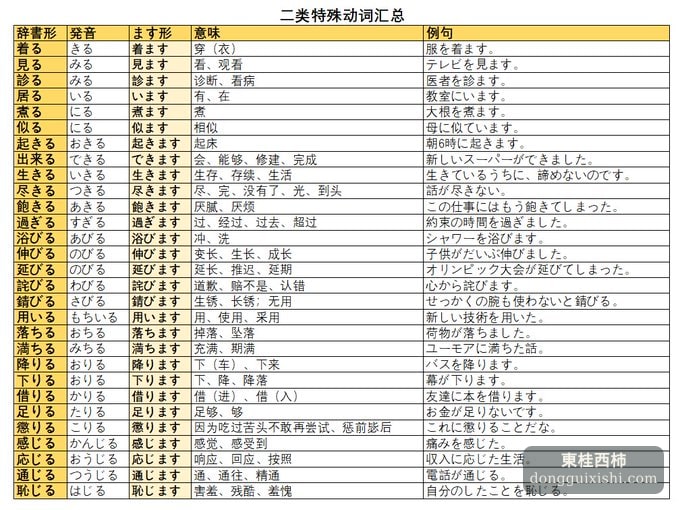
Something I Once Heard
When I first came to Japan, there was a story circulating in Chinese-speaking circles. It said that Japan originally taught international students dictionary form and plain form first, but later found that students could not speak politely when dealing with government staff. So the government supposedly decided this was not acceptable and changed the teaching order to start with masu-form.
At first, I did not question it. Now I think it is completely made up. After going to city hall many times, I found that for many common phrases, staff themselves often use plain forms directly.
In short, my current view is that teaching masu-form first is probably convenient for classifying verbs and for later conjugation practice. The extra step feels annoying only at the beginning. Once you become more familiar, that feeling disappears. Also, many practical uses contain the masu-stem without ます itself.
This also follows a gradual learning path. I hope we do not blame our early headaches on stories like the one above and then feel justified in giving up. Thinking more about why is always better than simply repeating what others say. 皆さん、頑張って下さい。