
Set Up an Overseas Company, Stripe, and a Bank Account in About Three Weeks: A Current Global Payments Guide for Solo Developers
Over the past two years, the environment around overseas payments and company registration has changed a lot. Many approaches that used to work almost casually have tightened significantly:
- Bank risk controls are stricter.
- Stripe and KYC reviews are more frequent.
- Platforms such as OpenAI and Google are starting to cross-check identity, IP address, and billing address.
- Many “one-click setup” accounts have run into bans and frozen funds.
At the same time, genuinely compliant and stable long-term setups have become more mature.
This year I reorganized a practical process covering company registration, EIN application, U.S. business banking, Stripe, Wise, and USDT cash flow. Most of it can be done from China, and the overall setup is more standardized and sustainable.
The core goal is simple:
To help solo developers and small teams building for global markets gain stable, long-term access to international payments.
This includes:
- Stripe global card payments
- USD / EUR / USDT receipts
- Overseas SaaS subscription payments
- Apple / Google developer accounts
- Payments for OpenAI / Claude / Cursor and similar services
- Overseas advertising platform payouts
- Overseas virtual card spending
Below is a setup that is still relatively effective and stable today.
Why Is It Still Worth Registering an Overseas Company?
Many people wonder:
“If I am only building a small indie product, do I really need this?”
In reality, for products targeting overseas users, an overseas business entity is increasingly becoming part of the basic infrastructure.
There are four practical reasons.
1. Stripe Has Almost Become Essential
Whether you are building:
- SaaS
- AI products
- Digital products
- API services
- Overseas subscriptions
you will very likely end up integrating Stripe. But Stripe’s restrictions on individual accounts from mainland China have become more obvious:
- Limited supported regions
- Stricter risk controls
- More requests for additional documents
- Some business categories are hard to activate
An overseas company is usually much more stable.
2. Many Overseas Services Now Verify More Strictly
The old days of “having a Visa card is enough” are gone.
Many platforms now cross-check:
- Company entity
- Bank account
- Billing address
- Phone number
- IP region
- Tax information
This is especially true for:
- OpenAI
- Anthropic
- Apple
- Stripe
All of them are stricter than they were two years ago.
3. An Overseas Bank Account Is Becoming More Important
With an overseas account, you can:
- Receive USD more reliably
- Connect Stripe
- Apply for virtual cards
- Pay for overseas SaaS tools
- Receive advertising platform payouts
- Reduce the risk of mixing personal and business funds
For anyone serious about building globally over the long term, this matters a lot.
4. Compliance Matters More Than Before
From 2024 to 2026, the biggest change is clear:
Grey-area shortcuts are becoming harder to sustain.
The most stable setup today is usually:
- Real identity
- Real business
- Real website
- Normal payment flows
- Normal tax filing
Avoid:
- Fake documents
- Purchased accounts
- Fake addresses
- Black-market cards
- Fabricated businesses
Many account bans are not really “false positives.” They happen because the information chain does not match.
The Full Process, 2026 Version
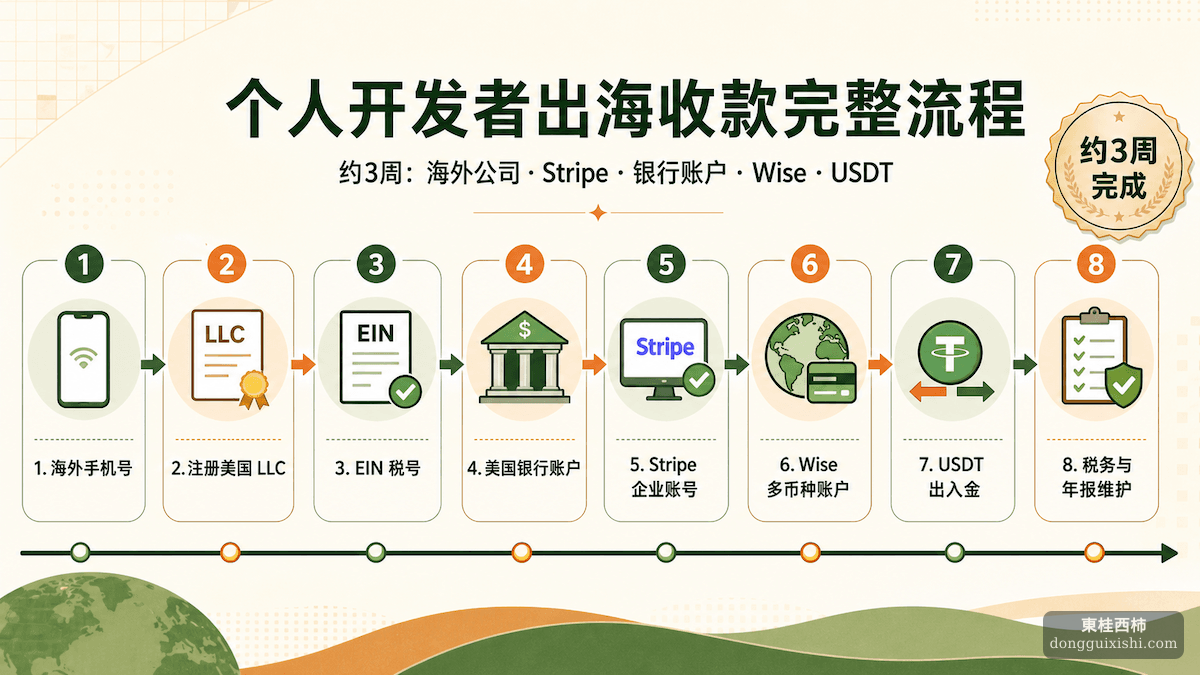
The complete flow looks like this:
- Overseas phone number
- U.S. LLC registration
- EIN tax number
- U.S. business bank account
- Stripe business account
- Wise multi-currency account
- USDT cash in and out
- Company renewal and tax maintenance
1. Overseas Phone Number
It is still useful to prepare:
- A U.S. number
- Or a U.K. number
These are mainly used for:
- Bank verification
- Stripe
- Two-factor verification on overseas platforms
U.S. Phone Number
The more common options include:
Compared with two years ago, many VoIP numbers no longer pass verification for:
- Stripe
- Banks
- OpenAI
- Google Voice
I recommend using a real SIM or eSIM when possible.
U.K. Phone Number
A relatively stable choice is still:
Its advantages:
- Easy to keep long term
- Stable roaming
- SMS support
- Low cost
Usually, one activity within six months is enough to keep the number active.
2. Company Registration
Why Is a U.S. LLC More Recommended Now?
For solo developers, the mainstream options are still:
- U.K. LTD
- U.S. LLC
But in real usage, a U.S. LLC often feels more practical.
Advantages of a U.K. Company
- Cheap to register
- Fast setup
- Low annual maintenance cost
Advantages of a U.S. LLC
- More complete Stripe ecosystem
- Better banking support
- Friendlier for SaaS integrations
- Best compatibility with overseas platforms
For:
- AI products
- SaaS
- APIs
- Indie development
a U.S. LLC is still the more mainstream choice.
Which State Should You Choose?
The most common options remain:
- Wyoming
- Delaware
Solo developers usually prioritize Wyoming.
Reasons:
- Lower cost
- Simple annual report
- Better privacy
- Cheaper maintenance
Which Registration Platform Should You Use?
Two years ago, many people used Firstbase. It still works, but the price is no longer especially attractive. Common options today include:
If your English is good enough, you can:
- Register the LLC yourself
- Apply for the EIN yourself
- Open the account yourself
That can save a lot of money.
3. EIN, the U.S. Tax Number
An EIN is like the company’s identity number. Stripe, banks, and tax filing all need it.
Before:
- EINs often arrived within a few days
Now:
- IRS review time is noticeably longer
- It usually takes 2 to 6 weeks
So:
Do not wait until your product is about to launch before registering the company.
Prepare earlier if you can.
4. U.S. Business Bank Account, the Important Part
This is now one of the strictest parts of the setup.
Over the past two years:
- Many cross-border users have been reviewed.
- Some fintech banks have closed accounts in batches.
So:
Long-term stability matters more than instant account opening.
Current Mainstream Options
1. Mercury
Still one of the most common choices for solo developers:
Advantages:
- Good Stripe compatibility
- Clean UI
- Convenient virtual cards
- API support
- Multiple cards available
Disadvantages:
- Risk control is much stricter than before
- Stronger requirements for real business activity
The key points for account opening now:
- Have a real website
- Have a real product
- Have a clear business description
Do not look like an empty shell.
2. Relay
Many people now use it as an alternative to Mercury.
3. Wise Business
Wise is no longer just a “money transfer tool.” Many small teams use Wise directly as their main account.
5. Stripe, the Part That Has Changed the Most
Two years ago:
- Stripe often approved accounts quite easily.
Now:
- KYC is much stricter.
- Reviews can continue after approval.
- More materials may be requested.
- Website authenticity is checked more carefully.
Even so, Stripe remains the strongest global payment tool:
The Most Important Stripe Points Today
1. You Must Have a Real Website
Avoid:
- Blank pages
- A single landing page only
- No privacy policy
- No terms
- No contact information
At minimum, prepare:
- Product introduction
- Pricing
- Privacy Policy
- Terms of Service
- Contact
2. Your Business Description Must Be Real
Stripe already uses a lot of AI-driven risk control.
Do not write vague descriptions such as:
- vague AI service
- consulting
Be more specific, for example:
- AI writing tool
- API service
- SaaS analytics platform
3. Do Not Generate Large Sudden Volume at the Beginning
New accounts are most sensitive to:
- Abnormal short-term growth
- High refund rates
- Many disputes
These can easily trigger a review.
6. Wise Is Still Very Important
It remains one of the most practical multi-currency tools for mainland Chinese users.
It supports:
- USD
- EUR
- GBP
- JPY
And:
- Exchange rates are transparent
- Transfers are fast
- Withdrawals are convenient
What Has Changed With Wise?
1. Physical Card Restrictions Have Increased
Some regions no longer support direct card applications.
But:
- The multi-currency account is still very useful.
- The business account still has strong value.
2. Wise + Stripe Is Still a Stable Combination
Many indie developers still use:
Stripe → Wise → domestic bank card
7. USDT Cash Flow
This part requires extra attention to compliance and risk.
Common routes today include:
- Kraken
- Coinbase
- Binance, with more restrictions in some regions
Among them:
has long had decent compatibility with international wire transfers.
A common path is:
USDT → Kraken → EUR → Wise
Reasons:
- Low SEPA fees
- Stable EUR channel
- Fast arrival
But:
I do not recommend frequent large personal fund transfers.
Banks now review crypto-related activity much more carefully.
8. Tax Filing and Annual Maintenance
How much does a complete setup cost now?
Basic Annual Cost
| Item | Cost Range |
|---|---|
| U.S. LLC registration | $100~500 |
| Registered Agent | $50~150/year |
| Wyoming annual fee | ~$60 |
| U.S. phone number | $36~100/year |
| Virtual address | $50~300/year |
| Tax filing service | $100~500/year |
Compared with two years ago:
- It is more expensive overall.
- But the tools are much more mature.
Company Renewal and Tax Maintenance
Many people assume:
“Once the company is registered, the work is done.”
In reality, the truly troublesome part is the ongoing maintenance. A U.S. LLC usually involves at least the following every year:
- Annual Report at the state level
- Registered Agent renewal
- Federal tax filing
- BOI, or Beneficial Ownership Information, reporting
- Address maintenance
Even if there is no revenue, that does not necessarily mean there is nothing to file. Over the past two years, many people have run into problems because of:
- Forgotten annual reports
- Missed tax filings
- Missing BOI reports
These issues can lead to company invalidation, bank risk reviews, or abnormal Stripe reviews. I recommend treating the setup as a long-term business from the beginning, rather than thinking only about getting the company opened first.
Common Pitfalls This Year
1. Do Not Buy Ready-Made Accounts
This includes:
- Stripe
- Bank accounts
- OpenAI
- Apple Developer accounts
Association detection is becoming stronger.
2. IP Inconsistency
If you often use:
- Japan IP
- U.S. company
- China login
- European phone number
you can easily trigger risk controls.
At least keep:
- Your usual region stable
- Your browser environment stable
3. Do Not Use a Fake Business
Banks are most afraid of:
- Empty-shell companies
- No real business activity
I suggest having at least:
- A product website
- Users
- Social media presence
- A clear payment logic
Final Advice
For global products this year, the most important question is no longer:
“How do I get around the rules?”
It is:
“How do I survive steadily over the long term?”
Many old “clever tricks” are gradually failing. A truly stable setup usually means:
- Real identity
- Real business
- Normal website
- Normal cash flow
- Normal tax filing
That is often the most worry-free path.
If you are serious about building:
- AI products
- SaaS
- Indie software
- Overseas content monetization
then:
Overseas company + Stripe + bank account has basically become infrastructure.