
Beginner-Friendly IT 1: If You Want to Build a Product, First Understand These Five Things
Today, many people with little or no technical background want to build websites, tools, apps, mini programs, or AI applications.
The first trap is to ask:
Which programming language should I learn?
That question is not wrong, but it comes too early.
For an IT beginner, the first thing to understand is what a software product is made of. You do not have to write code immediately, but you should at least understand what other people are talking about and roughly judge whether AI-generated code makes sense.
1. Software Is Not One Thing, but a Set of Parts Working Together
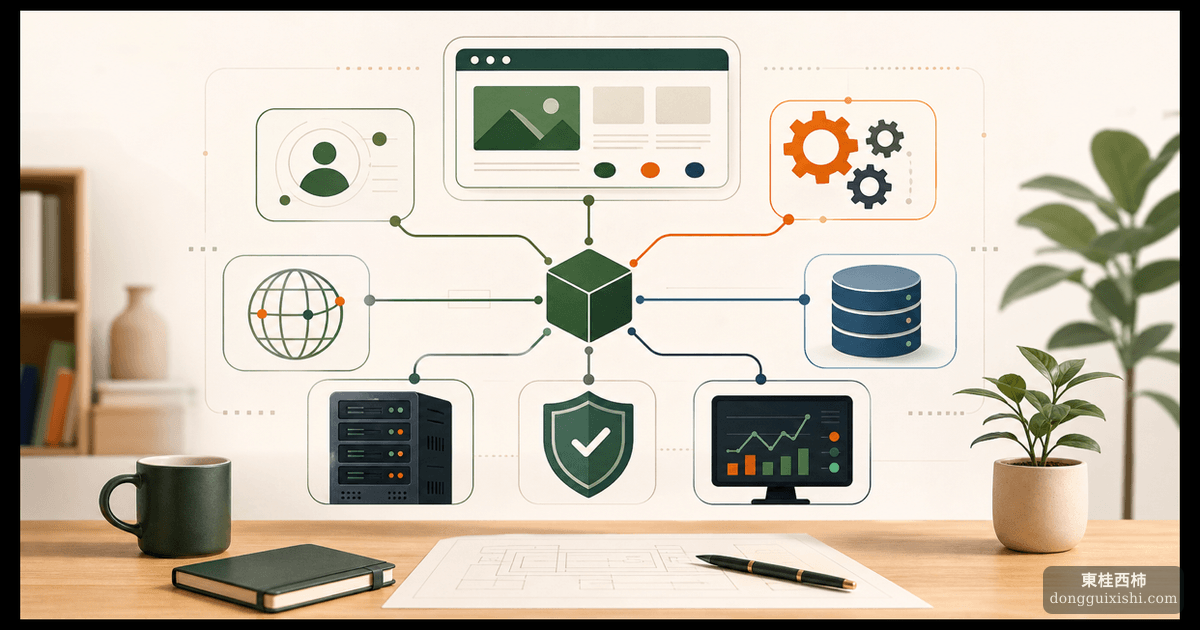
A normal software product usually includes at least these parts:
- Frontend: the interface users see and operate
- Backend: the rules, data, and business logic
- Database: stores users, orders, articles, files, and records
- Server: where the program keeps running
- Domain and HTTPS: how users access it safely
- Logs and monitoring: how you know what broke
If software is a restaurant, the frontend is the storefront and waiters, the backend is the kitchen, the database is the storage room, and the server is the building.
You do not need to know how to cook yet, but you should know that ordering, cooking, storing ingredients, and checkout are not the same thing.
2. AI Can Write Code, but It Cannot Take Responsibility for You
AI coding tools such as Codex, Cursor, and Claude Code are already powerful. They can write pages, APIs, scripts, tests, and even help debug errors.
But the biggest issue with AI is not that it cannot write. The issue is:
- It may misunderstand the requirement.
- It may write code that runs but is unsafe.
- It may take a complicated route.
- It may over-engineer simple problems.
- It does not know your business goal.
So a beginner does not need to become a programmer first, but must gradually become a software-aware owner.
You need to explain:
- Who the product is for
- What users will enter
- What the system must save
- Which parts must not go wrong
- What happens if data is lost
- Where money comes from and where it goes
These questions are more important than immediately arguing about Python, Go, Node.js, Java, or PHP.
3. Do Not Chase Full-Stack First. Chase a Closed Loop
Many learning paths push people through Linux, frontend, backend, database, and algorithms.
That may help people looking for developer jobs, but for someone trying to build a small product, it often leads to months of learning without shipping anything.
A better order is:
- Understand how a website opens
- Understand what frontend, backend, and database do
- Use a mature system to build a usable backend first
- Use AI to help fill in pages and APIs
- Learn deployment, backups, and troubleshooting
Shipping a small closed loop matters more than bookmarking a hundred tutorials.
4. Mature Systems Are Better for Beginners Than Starting from Scratch
Many features should not be written from zero:
- User login
- Permission management
- Content management
- File upload
- Admin panels
- Data forms
There are already mature systems for these needs, such as WordPress, Shopify, Payload CMS, Strapi, Directus, Supabase, Appwrite, and Laravel + Filament.
What a beginner should learn is not “I must write everything myself,” but:
Which parts should use mature systems, and which parts truly need custom development?
That is the more practical path: cheaper, faster, and lower risk, especially around security, which beginners often do not even notice.
5. Technical Judgment Will Matter Most
In the AI era, technical barriers will fall, but judgment barriers will rise.
In the past, if you could not code, many things were impossible. Now AI can write code for you. But if you do not understand software structure at all, you may end up with:
- Something impossible to maintain
- A product that breaks as soon as it goes online
- A chaotic data structure
- Rising costs
- A project controlled by vendors or tools
This Beginner-Friendly IT series will not start by teaching commands or complex architecture.
First, we will use simple language to explain the most important parts of the software world.
The goal is simple:
When you talk with AI, programmers, outsourcing teams, or technical partners, you should no longer be completely lost or easily misled.