
Notes from Japan: Water, Work, and People
It has been a long time since I last wrote. Is it because I have nothing to say? Not at all. In fact, there is more and more I could say. I have drafted many thoughts in my head, but some felt unsuitable, and for others I simply lacked the energy, so I let them go.
Although I am now working in Japan, I am still far from feeling at ease. Sometimes I do not want to write too much about these things, because readers who only skim may think it is all negative emotion. Today I will write some scattered notes. Those who pay attention may see what I mean; those who do not think too deeply can treat it as a curious little show.
Drinking Water
When we were children, if we were thirsty, we would scoop water directly from the river and drink it. We did not get diarrhea, though many children had roundworms. I do not know whether that had a direct connection with drinking untreated river water. Not long after, tap water became common. At first, we could not understand it. We had so many clear rivers, lakes, and wells. Why pay for tap water that smelled of bleach?
As children, we did not care. At home or at school, we drank straight from the tap. Mostly boys did this; fewer girls did.
Soon, water quality worsened. Nobody drank river water anymore, and even tap water was no longer drunk directly. Then bottled water and large water dispensers appeared and became very popular.
Now at home, I drink purified water or order bottled water, and I also use a German-brand filter cartridge, which costs about 50 to 60 yuan per month.
Before coming to Japan, I knew people in Europe and America drank tap water directly. Because I knew a bit about the water purifier industry in China, I assumed ordinary households would install purification equipment, such as a softener for bathing and a purifier for direct drinking.
After coming to Japan, I learned that Japan’s tap-water standards are high and that it can be drunk directly, somewhat like when we were children. At the same time, I noticed a few phenomena:
- Japan also has almost the same sales tactics for water purifiers as in China, such as electrolyzing a cup of tap water to show users how “dirty” it is.
- Many Japanese households go to nearby supermarkets to get free purified water. Perhaps bottled water in Japan is expensive, and ordering large bottles is also costly. A small 5-liter container can cost close to 1,000 yen, and disinfecting a container can also cost several hundred yen.
- In some public places in China, there are direct-drinking-water machines with filters such as reverse-osmosis membranes, activated carbon, or ordinary filter cotton. Many places in Japan also have machines that look similar. At first I thought they worked the same way, but many people who had lived here longer told me those machines are just tap water without additional filtering.
After more than a year in Japan, I basically drink boiled tap water. Some people say Japan’s water is hard and that drinking it for a long time may cause hair loss. This has not happened to me, so I neither confirm nor deny it. After publishing the original article, some readers reminded me that I should add a more precise note.
Water hardness is closely related to scale formation when boiling water.
Hard water contains more dissolved minerals, mainly calcium ions and magnesium ions.
When hard water is heated, these dissolved minerals reach saturation and precipitate, forming scale.
In practice, when boiling Japanese tap water, my kettle produces almost no scale. So if you drank tap water back home and washed your hair directly with tap water without problems, there is no need to worry too much about whether Japanese tap water is hard.
If I had the money, I would choose purified water. This is not because Japanese tap water is bad. It may be due to pipes, because the water that comes out can contain small impurities. I suspect this is also why some Japanese families living frugally still go through the effort of collecting water from farther away.
Income from Work
As for wages in Japan, the government seems to set hourly minimum wages, while most companies pay monthly salaries. This topic may be somewhat complicated, and I do not have the energy to study it deeply. Although it concerns money, for now I will leave it as it is.
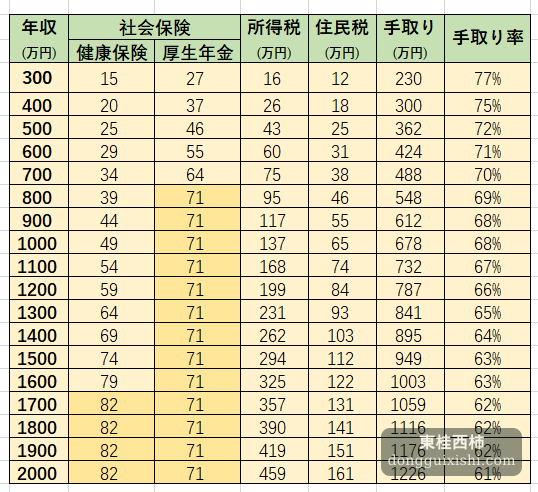
Take-home pay is generally salary after social insurance and taxes are deducted. Social insurance includes health insurance, long-term care insurance, employees’ pension, employment insurance, and so on. Taxes include withholding income tax and resident tax.
I heard long-term care insurance starts after age 40. Health insurance is medical insurance. One good thing in Japan is that if one person has health insurance, the spouse and children can also receive coverage without paying separately. Employees’ pension is the pension system, and employment insurance is roughly similar to unemployment insurance.
I currently pay health insurance, employees’ pension, and employment insurance. Health insurance and employees’ pension together account for about 28% of wages, shared half by the individual and half by the company. Employment insurance is a little over 1%, with the company paying a larger share. Overall, the ratio is basically similar to China. The difference is that in China, many companies pay based on the local minimum standard required by the government, rather than the employee’s actual full salary.
For taxes, withholding income tax is similar to individual income tax in China and has some deductions. Resident tax seems to start from the second working year. These taxes also seem to have systems somewhat like China’s tax refund policies. For example, there is hometown tax: after paying taxes, you can buy products through certain websites. I looked at some of them, and when the same product is available elsewhere, the price on those sites is often much higher. Still, there is no need to worry too much in advance. In Japan, when you reach each step, it is usually easy to follow because the instructions are very detailed. But if you try to understand everything ahead of time, many things feel much harder.
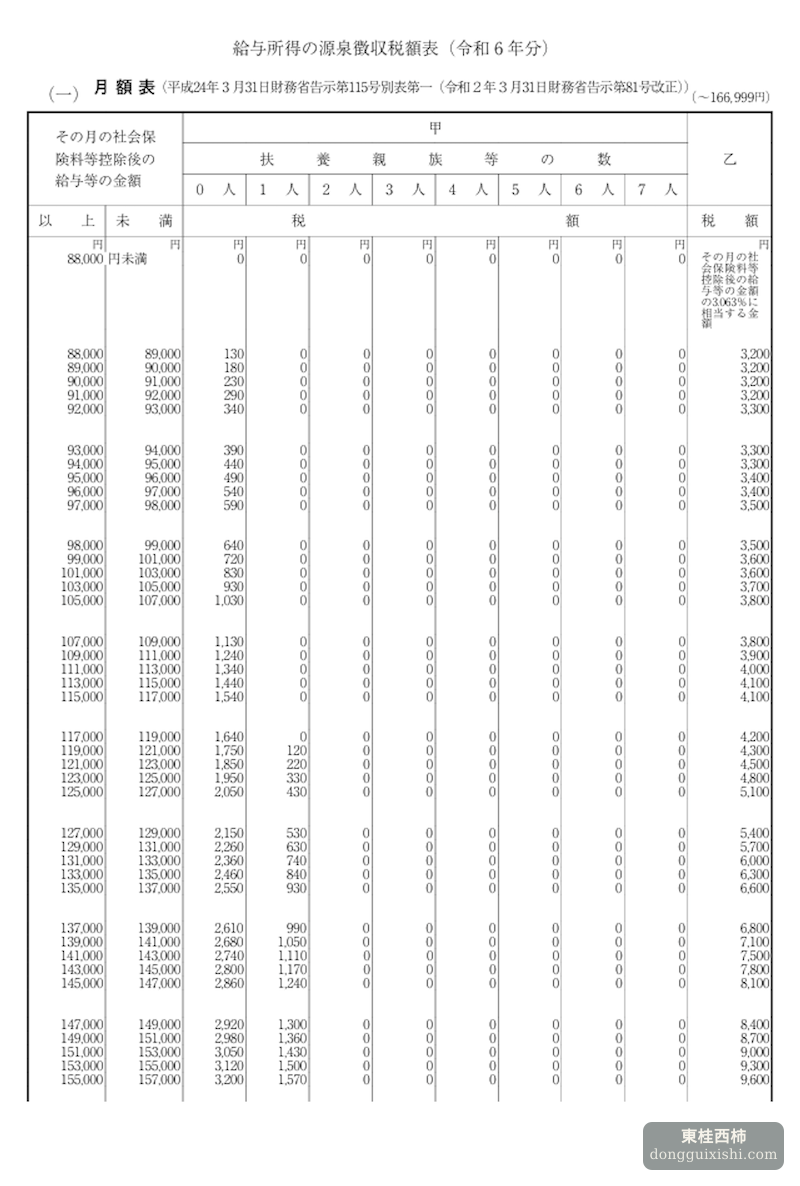
For almost every part, there are tables like the ones below. You do not need to calculate much yourself; you can simply look up the result. The second image gives a rough idea. The full assessment base for health insurance is 1.39 million times 12, or 16.68 million yen per year. The full assessment base for employees’ pension is 650,000 times 12, or 7.8 million yen per year.
People I Have Met
Last year, the Chinese people I met who were living relatively stable lives in Japan tended to share these traits:
- They had been in Japan long enough, roughly around 20 years.
- Or their spouse was Japanese, not a naturalized Chinese person, but someone born and raised in Japan.
- Their jobs were ordinary and incomes average, so their living standards were also fairly ordinary.
They seemed to share one common feature: no matter how outgoing they were, or how hard they had once studied Japanese, they were not especially confident deep down.
This year, the people I met who are living and working more comfortably in Japan felt like they belonged to another world. The stratification is obvious. Their traits include:
- Most have graduate degrees, meaning master’s or doctoral degrees, though some may be from less rigorous programs.
- Or their partner or spouse has considerable knowledge and experience of Japan, even if not a full Japan expert.
- Some may be quite wealthy, but it is hard to tell. Perhaps because they are in a foreign country, it is difficult to feel truly secure. I have even seen people with eight-figure savings still going to supermarkets for free water. If I had that much money, I would definitely just order water.
I belong to an awkward middle layer. But following my writing may have one benefit: when you look at the groups above, you may feel more grounded; when you look at groups further below, you may feel more confused. Whether grounded or confused, they can all feel floating and far away.
People like us may be easier to use as a reference. Think of us as the international prototype kilogram stored in France, or the old meter prototype. At least we may help measure the route a little more accurately.
There are many stories from the Three Kingdoms. If you ask me which one first comes to mind, it is always “The Death of Yang Xiu.” When we arrive in a new world and a new environment, because everything is new, our cleverness can easily help us spot places where we might show off or take shortcuts.
I think less self-satisfied cleverness and more respect for the unknown are what allow us to walk steadily and go far. Every time you try to be too clever, you create another target for yourself. You add invisible resistance, which is not worth it.
または
For a long time, I may not be able to run the Donggui Xishi community properly because of circumstances beyond my control. Still, I hope we can continue moving through wind and rain together. Nietzsche may not be highly regarded by some people, but one sentence of his has helped me: we should not seek to live better, but to live more.