
Watching Baseball in Japan: A Simple Guide and the Passion of Koshien
After coming to Japan, I often see groups of students playing baseball. To be honest, though, I had no idea how to watch a baseball game. I had barely watched baseball before. I only knew the phrase “home run,” and even then I did not really know what it meant. I just knew it had something to do with hitting the ball out of the field.
Baseball Culture in Japan
Baseball is deeply rooted in Japan and is one of the country’s most popular sports. It was introduced to Japan by an American teacher in 1872 and quickly spread across the country.
Today, both professional leagues and student tournaments attract large audiences. Nippon Professional Baseball, or NPB, is one of the highest-level baseball leagues in the world.
School baseball teams also compete in national tournaments in spring and summer. These events hold an important place in Japanese society and often draw nationwide attention.
Understanding Baseball
After spending some time learning the basics, I finally understand how to watch a baseball game. As people say online, it was invented by Americans, so it is not as complicated as it first looks. To describe it visually, it feels a bit like the board game Aeroplane Chess we played as children. Below is my simple introduction, so you can get started in a few minutes.
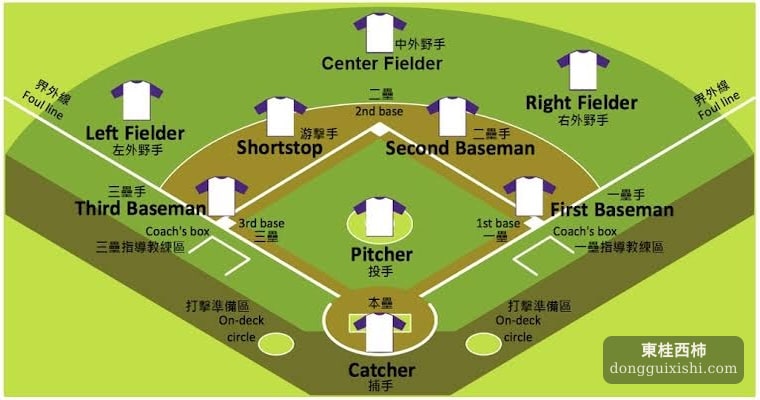
- A baseball game has 9 innings. Each inning is divided into a top half and a bottom half, and the two teams switch between offense and defense.
- Each team has 9 players. When a team is on defense, all 9 players are on the field. When a team is on offense, players take turns batting.
- The defensive team tries to get 3 offensive players out as quickly as possible. Once 3 players are out, that half-inning ends. Before that happens, the half-inning continues.
- A team can score only when it is on offense.
- A baseball field is divided into the infield and the outfield. The area where the batter stands is home plate. Going counterclockwise, the bases are first base, second base, and third base. The area inside these four bases is the infield, and everything beyond it is the outfield.
- After hitting the ball, the batter runs toward first base. As long as the batter touches the base bag safely, they are safe. Later, when another offensive player comes up to bat, the previous batter becomes a runner. In simple terms, an offensive runner scores after touching all the bases and returning to home plate.
- A home run means the batter hits the ball out of the field. Since the defense cannot field the ball normally, the batter can run all the way around the bases and score directly.
- The defense can get an offensive player out in several common ways:
- The same pitcher throws 3 strikes, and the batter fails to hit.
- A defensive player catches the ball before it touches the ground.
- A defensive player holding the ball tags a runner who has left the base.
- A defensive player holding the ball touches the base before the runner reaches the base they are trying to run to.
That is the rough idea. Of course, there are many additional details, such as what counts as a strike or a ball, and the fact that only one runner can safely occupy a base. Baseball rules are not overly complex, but to truly understand and enjoy the details, you still need to watch a few games. A baseball game is full of strategy and technique: the pitcher’s delivery, the batter’s timing, and a runner’s speed and judgment can all affect the result.
The Youthful Passion of Koshien
Before coming to Japan, I had heard the word “Koshien,” but since I had never looked into it, I had no idea what it really meant. Later, after my Japanese teacher explained it, I finally understood.
Koshien is a famous baseball stadium located in Kobe. Every summer, it hosts the National High School Baseball Championship, known as Summer Koshien. This tournament is one of Japan’s most important amateur baseball events and attracts attention from across the country. Koshien is also the home stadium of the Hanshin Tigers.
After coming to Japan, I experienced the atmosphere of the national high-school baseball tournament during summer. It really is full of youthful passion. If you like baseball, it is something you should not miss.