
Japan’s IT Industry at a Crossroads: Mega Mergers and the Evolution of the Outsourcing Model
As digital transformation (DX) enters a more advanced stage and Generative AI becomes deeply embedded across industries in 2026, Japan’s IT sector is undergoing one of the most significant restructurings in its history.
The traditional development model—characterized by fragmented organizations, multi-layer subcontracting, and labor-based billing—is gradually giving way to a new era of industrial consolidation. Major system integrators (SIers) are accelerating mergers within their own corporate groups while also acquiring complementary software and infrastructure companies to strengthen their market positions.
Rather than simply becoming larger, these companies are fundamentally reshaping how enterprise IT services are delivered in the AI era.
1. The Latest Wave of Consolidation Among Japan’s SIers
The “Super Tier”: Trillion-Yen National Champions
Japan’s highest tier of SIers consists of four giants: NTT DATA, Fujitsu, Hitachi, and NEC.
With annual revenues ranging from one to four trillion yen, these companies dominate mission-critical projects for the Japanese government, financial institutions, telecommunications, and other national infrastructure.
NTT DATA: Integrating Telecommunications and IT into a Global Digital Powerhouse
Between 2025 and 2026, NTT completed one of the largest corporate restructurings in Japan’s recent history by acquiring all remaining shares of NTT DATA Group through a tender offer worth approximately 2.37 trillion yen, making the company a wholly owned subsidiary and delisting it from the stock market.
The strategic objective extends far beyond a simple corporate restructuring.
By fully integrating NTT’s global telecommunications infrastructure—including submarine cable networks—and NTT DATA’s strengths in system integration, cloud services, and data centers, the group aims to eliminate conflicts between minority shareholders and long-term strategic investments.
More importantly, it allows NTT to concentrate resources on AI infrastructure, cloud computing, and hyperscale data centers, positioning itself as a comprehensive digital services provider capable of competing with global technology leaders.
Fujitsu: Bringing Talent Back to Headquarters
Fujitsu has also announced the full integration of Fujitsu Japan, the subsidiary responsible for serving regional governments and small-to-medium-sized enterprises, back into the parent organization.
For years, responsibilities were distributed across multiple subsidiaries, each specializing in different markets or technologies. While this structure once improved operational efficiency, it has increasingly become a barrier to AI innovation, where research talent and engineering resources need to work much more closely together.
Like many other industry leaders, Fujitsu is now reversing this decentralization strategy, concentrating technical expertise and decision-making within a unified organization to accelerate AI and cloud development.
The Upper First Tier: Breaking Down Internal and Industry Boundaries
Below the national champions is another group of industry leaders, including TIS, SCSK, CTC, and BIPROGY.
With annual revenues between 300 billion and 600 billion yen, these companies serve as primary contractors for large enterprises across Japan.
Unlike previous generations of SIers, today’s competition is no longer limited to software development alone. Companies are increasingly expanding into networking, cloud infrastructure, consulting, cybersecurity, and AI platforms, creating end-to-end service capabilities rather than isolated technical expertise.
TIS Creates “TISI”: Integrating Urban Expertise with Regional Delivery
On July 1, 2026, TIS completed the merger of its core subsidiary, INTEC, one of Japan’s long-established SIers. The newly integrated company was officially renamed TISI Corporation.
This merger represents more than a simple organizational restructuring.
TIS has traditionally maintained strong competitiveness in financial systems, payment platforms, and enterprise consulting for large metropolitan clients, while INTEC has accumulated more than six decades of experience serving regional governments and local enterprises.
By combining these complementary strengths, TISI aims to provide integrated solutions that cover everything from strategic consulting and system design to implementation and long-term operations, regardless of whether customers are located in Tokyo or regional Japan.
SCSK Acquires Net One Systems: Completing the Infrastructure Puzzle
After becoming a wholly owned subsidiary of Sumitomo Corporation through an ¥882 billion privatization, SCSK announced another landmark move.
The company plans to acquire Net One Systems, Japan’s leading network integration (NI) specialist, in a transaction valued at approximately ¥357.4 billion, with completion expected in April 2027.
For many years, SCSK excelled in enterprise software development and system integration but lacked strong capabilities in large-scale networking infrastructure.
Net One Systems fills precisely that gap.
The merger will allow SCSK to deliver end-to-end digital infrastructure—from network architecture and cloud platforms to application development, cybersecurity, and operational services—through a single organization.
Following the integration, annual revenue is expected to exceed ¥1 trillion, elevating SCSK into Japan’s top tier of comprehensive IT service providers.
CTC Expands Beyond Traditional System Integration
After being taken private by ITOCHU Corporation, CTC has accelerated its international expansion strategy.
In early 2026, the company completed the integration of the Japanese business of AKQA, one of the world’s leading digital experience agencies.
This acquisition reflects another important trend within Japan’s IT industry.
Historically, many SIers focused primarily on backend system development, while user experience (UX), branding, and digital design were handled separately by creative agencies.
Today, enterprise customers increasingly expect these capabilities to be delivered as a unified service.
By integrating customer experience (CX), digital design, and backend engineering under one organization, CTC is positioning itself as a comprehensive digital transformation partner rather than a conventional SI vendor.
2. Is Japan’s IT Outsourcing Industry Declining—or Simply Evolving?
Recent weakness among mid-sized IT staffing and outsourcing firms has led some observers to conclude that Japan’s outsourcing industry is entering a period of structural decline.
Companies whose business models rely primarily on engineer dispatch (SES) and contract development have generally faced slower growth. Some have even reported declining revenue and earnings despite offering attractive shareholder returns, reflecting growing pressure from both customers and investors.
At first glance, this seems to suggest that Japan’s traditional outsourcing model is losing relevance.
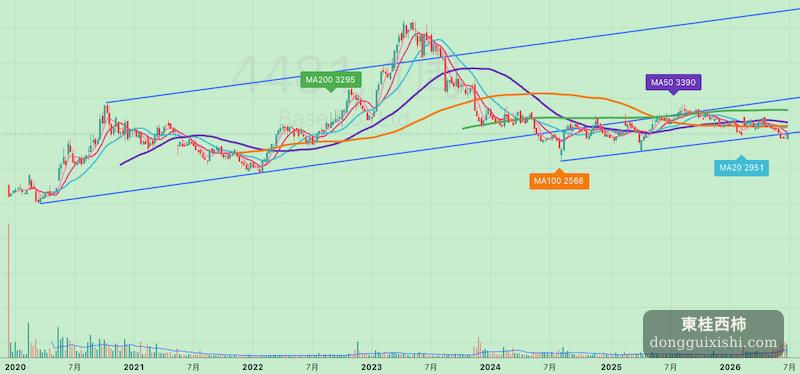
Base Co., Ltd., whose core businesses include engineer dispatch (SES) and contract software development, illustrates this trend. Despite announcing a special 30th-anniversary dividend that lifted its dividend yield above 6%, the company reported lower revenue and profit in the first quarter. With much of the previous optimism already priced in, the stock has recently come under heavy technical selling pressure and is approaching an important support level.
I believe that interpretation misses the bigger picture.
In my view, the overall demand for IT outsourcing in Japan has not disappeared. Instead, the industry is undergoing a profound shift in value creation.
The outsourcing market is not shrinking—it is moving up the value chain.
What Is Actually Declining?
Labor-Based Staffing and Multi-Tier Subcontracting
For decades, a significant portion of Japan’s IT outsourcing industry was built around a relatively simple model.
Clients defined their requirements.
System integrators then allocated engineers to projects, charging customers primarily based on headcount and working hours.
This approach produced Japan’s well-known multi-layer subcontracting structure, where large SIers outsourced work through several layers of partner companies before software was finally developed.
However, two major trends are now reshaping this model.
The first is in-house digital transformation.
More Japanese companies are building their own internal engineering organizations instead of outsourcing every stage of software development.
The second is the rapid adoption of Generative AI.
Tasks that once required junior programmers—such as writing boilerplate code, documentation, testing, and debugging—can increasingly be automated.
As a result, demand for large numbers of entry-level engineers is gradually declining.
Following the recent wave of consolidation among major SIers, large enterprises are also becoming more selective about external vendors.
Instead of simply hiring more engineers, they are prioritizing partners capable of delivering greater technical expertise and business value.
What Is Growing Instead?
Full-Stack, End-to-End Outsourcing
Modern enterprise customers rarely ask vendors to “build a system” anymore.
Instead, they ask much broader questions:
-
“How can AI redesign our business processes?”
-
“How should we modernize our entire digital infrastructure?”
Meeting these expectations requires capabilities far beyond software development.
Vendors now need industry consulting expertise, AI engineering, cloud platforms, cybersecurity, networking, data centers, and long-term operational support.
This is precisely why mergers such as TIS + INTEC and SCSK + Net One Systems are strategically significant.
Rather than offering isolated technical services, these companies are building organizations capable of delivering complete digital transformation from strategy to implementation.
Enterprise customers increasingly prefer working with a single strategic partner instead of coordinating multiple suppliers responsible for hardware, networking, software, security, and operations separately.
The future of outsourcing is therefore no longer about supplying labor.
It is about delivering integrated business solutions.
Final Thoughts
In my view, the balance of power within Japan’s IT industry is steadily shifting toward a small group of technology leaders that have successfully integrated software, infrastructure, networking, cloud computing, and AI capabilities.
Companies such as TISI and SCSK are no longer competing as traditional system integrators. Instead, they are positioning themselves as strategic partners capable of supporting customers throughout the entire digital transformation journey.
This also changes the meaning of “outsourcing.”
Rather than supplying engineering manpower, the next generation of outsourcing will focus on business architecture, AI adoption, and long-term digital strategy.
For smaller SIers and IT staffing companies that continue to rely primarily on engineer dispatch and labor-based billing, the coming years will likely become increasingly challenging.
Without investing in AI capabilities, cloud technologies, and higher-value consulting services, maintaining long-term competitiveness will become difficult.
What Does This Mean for IT Professionals?
For engineers planning to build a career in Japan, I believe this trend deserves close attention.
In the past, Japanese language ability alone often opened the door to many onsite development opportunities.
That environment is gradually changing.
As AI automates routine programming tasks and companies continue to strengthen in-house development teams, employers will place greater emphasis on technical depth, cross-disciplinary expertise, cloud architecture, AI, cybersecurity, and business communication skills.
Simply being able to code may no longer be enough.
What Does This Mean for IT Companies?
The same transformation applies to IT service providers.
Companies that continue to depend primarily on packaging resumes, dispatching engineers, or competing solely on labor costs may find it increasingly difficult to survive.
The market is shifting toward organizations capable of cultivating highly skilled engineers, developing proprietary technologies, and creating long-term value for clients.
In other words, technical capability—not headcount—will become the defining competitive advantage.
A Personal Perspective
Of course, no one can predict exactly how Japan’s IT industry will evolve over the coming years.
The observations presented in this article reflect my own analysis based on recent industry developments and public information.
If you have different opinions or alternative perspectives, I would be delighted to hear them.
Constructive discussions often lead to better understanding, and I hope to continue updating this article as new developments emerge.
After all, the transformation of Japan’s IT industry has only just begun.