
Garbage Sorting in Japan: Practice and Personal Notes
On the roads I have walked recently, I have hardly seen public trash cans or street cleaners, yet the environment is truly clean. Usually, there are dedicated bins beside vending machines.
Today I want to talk about garbage sorting, something many people may care about. Japan’s garbage sorting is not perfect, but it is definitely much better than what I was used to back home. Our apartment received a full-year garbage collection schedule from the local government. You simply check which type of waste can be thrown away on which day.
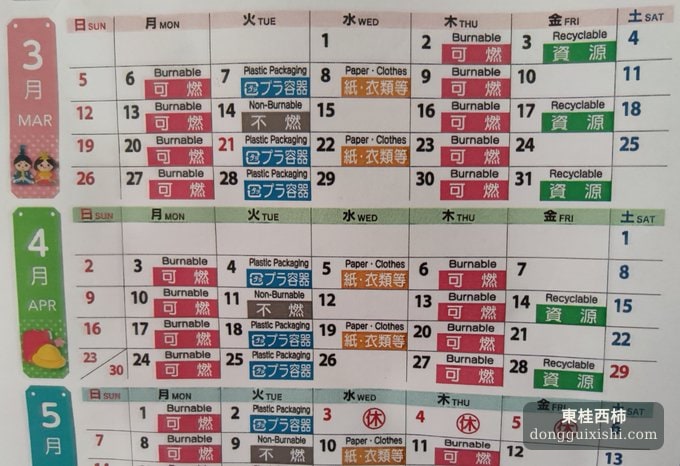
For ordinary household waste, the main categories are burnable waste, recyclables, and plastic containers or packaging. In my daily life, I mainly produce plastic packaging waste and burnable waste.
Plastic Waste
Plastic waste mainly includes plastic packaging boxes and bags, bento containers, bottle labels, and bottle caps. These usually have the plastic mark on them, so they are easy to identify.
I throw this away once a month, and it just about fills the largest city-designated garbage bag.
For packaging from meat and vegetables, I wash it clean and let it dry before putting it in the bag. Because of that, throwing it away once a month is completely fine, with no smell or insects.
Burnable Waste
Burnable waste mainly refers to kitchen scraps, fruit peels, and similar waste. This is a little more troublesome.
I throw it away once a week or sometimes less often. Ingredients in Japan are usually quite good, whether bought from supermarkets or vegetable shops, so they do not generate much waste. Each time, I only fill about half of the smallest city-designated bag.
I have a small trick for daily handling: I keep the small roll bags from shopping and used food-wrap bags. Whenever I have vegetable scraps or fruit peels, I put them in those bags and tie them tightly. Once they go into the garbage bag, there is no smell and little risk of small insects flying around.
Recyclables
For ordinary households, recyclables mainly include metal cans, plastic bottles, glass bottles, cardboard, books, newspapers, and similar paper.
Recyclables need to be packed separately. Plastic bottles go together, metal cans go together, cardboard is its own category, and glass bottles are also separate.
I almost never buy bottled water, and I do not drink soft drinks or beer, so I rarely produce this kind of waste. If I occasionally have one or two bottles, I place them in someone else’s existing bag when throwing them away.
Water bottles are easy to handle: the cap and label go into plastic waste, while the bottle itself is crushed and treated as recyclable. Cans, drink bottles, and glass bottles should be rinsed. Glass bottles need to be separated.
Recyclables can usually be thrown away once a month. If you rinse bottles and cans after use, they do not smell while being stored. Milk and juice cartons are a little more troublesome. It is best to open them flat, rinse them, dry them, and store them as paper waste. This kind of waste can also usually be thrown away once a month.
Paper and clothes may have separate collection days. These items are often heavy and relatively numerous.
I throw this kind of waste away every two or three months. It mainly consists of cardboard boxes, pamphlets, advertising flyers, milk cartons, and juice cartons. I open the cartons, rinse them, dry them, and dispose of them as paper waste.
Other Waste
Finally, there is non-burnable waste. For this, you should check the leaflet from your local area.
Large garbage generally means items too large to fit into the biggest city-designated garbage bag. You need to contact a waste collection company yourself.
I have also received a detailed garbage-sorting booklet, but I have not had time to study it carefully.
Where I currently live, burnable waste is collected every three or four days, plastic waste about once a week, recyclables and paper or clothes two or three times a month, and non-burnable waste once a month.
When renting a place, especially if it is not a managed apartment building, it is worth checking how garbage is handled in that area. Places that take garbage seriously are usually not too bad in other ways either.
In the town where I live now, people handle garbage cleanly and neatly. The overall level is quite high.
I think garbage sorting should be taken seriously, but there is no need to become overly anxious or obsessive about it. At the beginning, doing roughly what I described above is enough. You can gradually improve later.
As I have lived in Japan longer and learned more, this article, originally written more than a year ago, now feels a little one-sided. Different places in Japan can vary greatly in garbage-sorting rules.
Where I live now, throwing away garbage is generally more convenient than what I described above, mainly because most plastic packaging and milk cartons do not need to be separated. But some parts are more troublesome, such as rechargeable batteries being hard to dispose of, and foam food trays needing to be taken to supermarkets.