
Five Essential Cards for Living in Japan
After coming to Japan, there are five cards you will likely need:
- Residence card
- SIM card
- Bank card
- Health insurance card
- My Number card
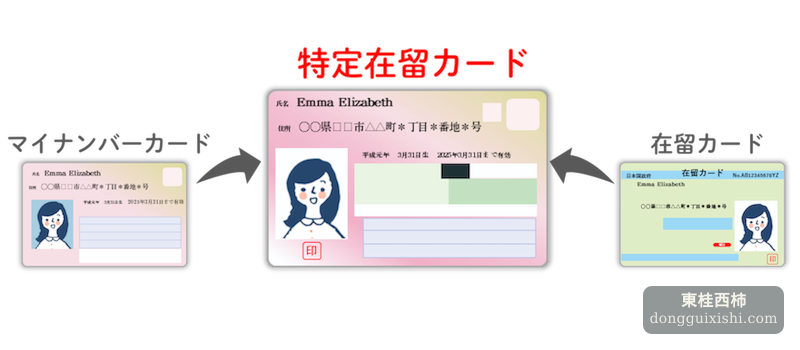
Starting from June 14, 2026, the Specified Residence Card System has been implemented in Japan. Eligible foreign nationals holding medium- to long-term residence status may apply for a Specified Residence Card.
The key feature of the Specified Residence Card is that it combines the Residence Card and the My Number Card (Individual Number Card) into a single card.
Residence Card
You can receive your residence card when entering Japan at the airport.
After that, it is best to carry it every day, because you will need it for many procedures. You may also encounter police checks on the street, and not having your residence card can be troublesome.
SIM Card
Many people may see online that applying for a SIM card in Japan requires a bank card, while applying for a bank card requires a phone number, making it feel like a dead loop. In reality, it is simple: apply for a SIM card first. It is not troublesome.
When applying, you fill out a form. You can leave a Chinese credit card, or not. If the form insists on one, you can first enter a debit card or a family member’s credit card. If phone fees are not automatically deducted, you will receive a bill and can take it to a convenience store to pay. This method adds a handling fee of several hundred yen.
Japanese mobile plans are roughly one or two times more expensive than China’s. For people who already used a lot of mobile service in China, online descriptions may feel exaggerated. But for people who only needed 30 or 50 yuan per month in China, it really can be several times more expensive. I currently pay around 3,000 to 4,000 yen per month, with unlimited data.
A few differences from China:
- Applying for a SIM card has a handling fee. When I applied, it was 3,000 yen. Tax is 10%, so if your monthly usage is 3,000 yen, the payment is 3,300 yen.
- It is postpaid. You do not top up first. It is similar to a credit card: the bill is issued on a fixed day each month, and you pay before the deadline. Installments or delayed payments involve additional fees.
- For data use, you may be able to switch between high-speed data and normal data, depending on the carrier’s plan. Normal-speed data usually does not count against the plan’s data allowance.
Finally, here is a simple example of how to pay a phone bill in cash in Japan, using Lawson.
At Lawson, find a machine like the one below. Press the first icon on the screen, then follow the prompts to enter your user number and confirmation code. The machine prints a receipt.
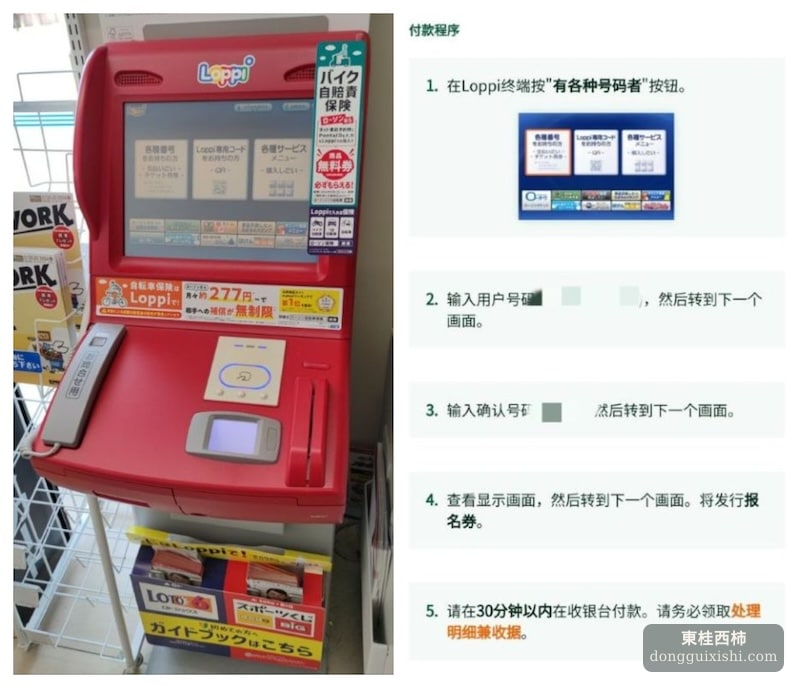
Then take the receipt to the cashier and pay. After payment, the cashier gives you a stamped receipt.
Bank Card
It is not very convenient for foreigners to open bank accounts in Japan. For many people, the first bank card is likely a Japan Post Bank cash card.
If you only use cards in China without paying attention to their names, Japan’s card system may feel confusing.
Japan still has cash cards, debit cards, and credit cards. In China, people generally use only debit cards and credit cards, which correspond to ordinary bank cards and credit cards in daily speech.
If you understand a little accounting, the names make sense. But many of us do not, so if you understand a Japanese cash card as the same as a Chinese debit card, it becomes confusing.
A cash card is more like cash access. It can be used for deposits, withdrawals, and some public payments, but not for card purchases.
- A debit card can be used for purchases but cannot overdraft. It is debit-side accounting.
- A credit card has a credit limit and is credit-side accounting.
These days, you do not need to exchange a lot of cash before coming to Japan. With a UnionPay card, it is convenient to withdraw cash from ATMs. 7-Eleven and Lawson convenience stores can do it. I have found Sumitomo Mitsui Bank to be relatively good overall: the ATM allows up to 100,000 yen per withdrawal, with only a 75-yen fee.
Health Insurance Card
For students, National Health Insurance in the first year is under 20,000 yen. After receiving the payment slips, you can pay at a convenience store, or scan the code and pay with the Japan Post card mentioned above.
You may receive nearly a full year’s bills at once. I paid monthly, though you can also pay all at once depending on your situation.
If the bill you receive is much higher than the amount I mentioned, you need to visit the city office and apply for the student reduction. It is not troublesome; just fill out a form. Staff will tell you to pay the first month’s bill at the higher amount first, and later you will receive new reduced bills. The total fee will then match the amount I mentioned.
Finally, be sure to take care of your health. Although private clinics are everywhere in Japan, hospitals are different from city offices. If your Japanese is weak, seeing a doctor is still somewhat troublesome. Also, insurance covers 70%, but each visit still usually costs you 2,000 to 4,000 yen, and it takes time.
Starting from December 2, 2024, the Japanese government stopped issuing new health insurance cards. Health insurance information is now linked to the My Number Card, and patients can receive medical treatment simply by presenting their My Number Card.
Health insurance cards issued under the previous system also became invalid and ceased to be usable from December 1, 2025.
My Number Card
After arriving in Japan with a medium- or long-term visa, you will soon receive a My Number notification. You can apply online following the letter’s instructions. You need to prepare a recent photo. After a successful application, the card is usually produced in about a month.
After it is ready, you go to the city or ward office to pick up the physical card and set passwords. Based on recent experience, for example in Tokyo, after receiving the pickup notice, you still need to reserve the pickup place and time online, which may take more than another month. So in Tokyo, from application to receiving the card, the whole process may take more than two months. I am not sure about the latest situation in other regions.
Also note:
- Each time you renew your residence card, you need to update the validity period of your My Number card. If your address changes, you also need to record the address change on the My Number card.
- If the My Number card expires, it cannot be reactivated. You need to apply for a new card, though the card number remains the same. Unlike the residence card, the old My Number card is taken back rather than simply punched with a hole.
Japan’s My Number card is similar to China’s ID card, though it does not seem fully popularized yet. Offline use cases are still relatively few.
However, many services can now be applied for online with this card. You need certain compatible phones or a dedicated card reader to authenticate the card.
Currently, the My Number card has several convenient uses:
Issuing a Residence Certificate
With a My Number card, you can issue a residence certificate through machines at city offices or convenience stores. It is convenient, saves time, and costs less.
Because the machines support multiple languages, operation is not difficult. Select the information you need and leave out what you do not need. Usually it takes two or three minutes to print the certificate.
It is cheaper too: machine issuance costs 150 yen, while counter issuance costs 350 yen.
As a Health Insurance Card
Japan’s National Health Insurance card has traditionally been a paper card, similar to an ordinary business card.
If you have a My Number card, you can link it with health insurance and use it instead of the insurance card when seeing a doctor. I have not used it yet, so I do not know the specific procedure.
The latest information is that from December 2024, paper health insurance cards will be abolished and replaced by My Number cards. Health insurance cards will no longer be issued separately in the future.
Applying for Bank Cards
If you have a My Number card, applying for a debit card or credit card can be a little more convenient.