
Renting in Japan: How Foreigners Can Find Housing
One logic of living in Japan is very different from China. Simply put, if you want to live in Japan medium to long term, you need an address and a phone number. Many later procedures revolve around you as an individual. For example, after you rent a place, contracts for water, electricity, gas, television, internet, and so on are tied to you personally, unlike in China where they are often tied to the property.
Below I will talk about renting in Japan. This topic is complex, and I do not claim to understand everything, so treat this as a basic orientation. This article will continue to be updated.
Japan has many rental platforms. From what I have seen, they are broadly similar. Here are a few, not as recommendations but as references: SUUMO, LIFULL HOME’S, and Able. These websites are also included in the Donggui Xishi community’s practical Japan websites list.
There are also many rental platforms aimed specifically at foreigners. In short, there are many options, and you can search on Google.
Basic Knowledge About Renting in Japan
Layouts
When I first saw terms like 1DK and 1LDK, I had no idea what they meant. The screenshot below shows filters on a rental website.
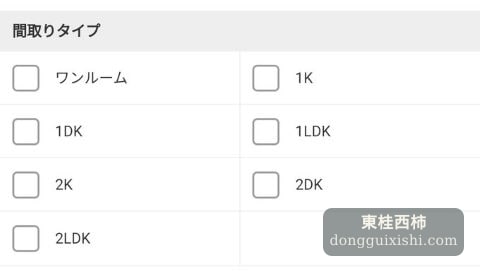
DK stands for dining and kitchen. The number before it indicates the number of rooms. For example, 1DK is roughly equivalent to a one-bedroom unit with dining/kitchen and bathroom.
LDK adds living, meaning living room, dining area, and kitchen.
Japanese bathrooms are usually separated into dry and wet areas. The toilet is separate, the bath is separate, and the washbasin is also separate.
Unless it is a special case, a rental unit with only one room still includes the bathroom facilities described above by default, so they are not listed separately.
No Furniture or Appliances
Most rental homes in Japan are empty. They do not include furniture or appliances. Water heaters and air conditioners are usually included.
No furniture means no tables, chairs, beds, wardrobes, and so on. No appliances means no refrigerator, washing machine, gas stove, or induction cooker.
If the unit does not have these, you can also ask the landlord to provide them. That often increases rent, guarantee fees, and cleaning fees. In general, buying these things yourself saves some money. But if you dislike the hassle or worry about disposing of them when moving later, and the landlord is willing to provide everything, that can also be convenient.
Points to Note
Foreigners renting in Japan generally need a Japanese guarantor. Many listings may clearly say that no guarantor is required, but often this only applies to Japanese tenants. Before visiting an agency, it is best to ask clearly in advance to avoid a wasted trip.
What Costs Are Involved?
Some familiar fees include key money, agency fees, and deposits.
My suggestion is not to get too caught up in the names of these fees. Pay attention to the total cost. Below are other common fees: guarantor-company fee, key replacement fee, insurance fee, and cleaning fee.
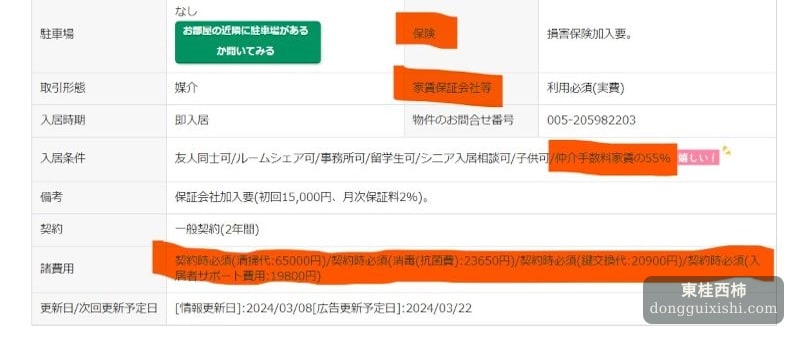
When renting in Japan, foreigners are generally required to sign with a guarantor company. If the tenant delays rent payment, the guarantor company pays first. The guarantor fee mentioned above is the cost of signing with that company. The initial fee may range from 50% to more than 100% of one month’s rent.
Japanese rental contracts are generally signed for two years, and renewal usually involves a renewal fee. Guarantor fees and insurance fees may also have annual renewal fees.
Rent in Japan is usually paid month by month. The monthly cost is rent plus additional fees such as common-area fees or management fees. These additional fees are usually a few thousand yen.
Based on my rental experience, the initial costs that you do not get back are about three to four months’ rent. Some people say renting from Chinese landlords can reduce these fees, but when you first arrive and do not know the area well, that may not be easy right away.
Another option I will mention below is renting UR housing or JKK public housing. I currently rent a UR unit, which is roughly similar to public rental housing. I heard JKK public housing is more like low-rent housing, but I do not know the details and will not expand on it. The UR Urban Renaissance Agency and JKK Tokyo websites are included in the Donggui Xishi practical Japan websites list.
Tenant Screening
For ordinary rentals, there may be a screening process. You may need to provide information such as your home address in China.
You may also need to provide a contact person in China and a contact person in Japan.
Renting UR Housing
UR, the Urban Renaissance Agency, is a semi-governmental organization in Japan responsible for providing and managing public housing.
UR housing refers to apartments or residential complexes managed by UR. The rent is often cheaper than private rentals when considered overall, and the procedure is relatively simple. There is no key money or agency fee, and restrictions on foreign tenants are relatively fewer.
1. How to Apply
First, you can search for available units on the official website. Some vacant units can be applied for directly online, while others cannot and require phone calls, emails, or visiting a local UR office. I still do not know exactly why.
You can also find people who specialize in helping with UR applications. Usually you do not need to pay them, because UR pays them a commission for certain listings. For listings without commission, you may still be able to pay them to handle the process.
After successfully applying for a unit, you can first take the key and inspect it yourself. If you think it is acceptable, you will later be assigned to a specific office to complete the contract.
Go to the designated place at the scheduled time to sign the contract. The whole process takes about two hours. The amount paid on site is two months’ rent as deposit, plus the first month’s rent calculated by day. Payment follows the natural month, unlike in China where it often starts from the contract start date.
There are no other fees.
2. Moving In
On the move-in date set during contract signing, you can go to the local UR office near your residence to pick up the key and move in.
The inside of UR units is also completely empty. You need to prepare everything yourself. During contract signing, they provide detailed instructions about how to install or place things such as air conditioners and washing machines.
3. Neighbor Discount
UR rentals may also have a neighbor discount. If you are introduced by an existing resident of the same complex, you may receive a 5% monthly rent reduction.
4. Comparison with China
So far, UR housing feels very similar to public rental housing in China.
- China’s public rental housing is also empty, and when moving out you need to clear all your belongings and restore the unit.
- Like public rental housing in China, popular new units may require a lottery.
- UR has application agents, and public rental housing in China also has people who help with applications, though the nature of the two is different.
- The deposit system and related arrangements also feel similar.
If you understand public rental housing in China, you can think of UR housing as the same concept under a different name. That should make it less unfamiliar.
Other Rental Options
I have heard of another option called monthly mansions, where you can rent by the month. The rent is higher, but you generally do not need an agency, and utilities may be included. If that is true, I think it can be a good temporary option when first arriving in Japan.
I do not know the details and am only providing a channel. You can look into websites such as Union Monthly, also included in the Donggui Xishi practical Japan websites list.
This article will continue to be updated and corrected. If you would like to contribute information, feel free to email me. Lighting a lamp for others also brightens your own life.