
What Income Lets a Family of Three Live Decently in Japan?
This month has been busy, tiring, and rather unlucky, with misfortunes appearing one after another as if guided by invisible hands. This weekend I rested and handled many small chores: restocking food, paying miscellaneous fees, preparing automatic rent withdrawal to save a few hundred yen in transfer fees, cleaning myself up, and doing housework.
Cleaning the small room made me sweat heavily. I was exhausted and almost dizzy. But gradually I found a method and summarized a three-step cleaning process:
- Sweep briefly first.
- Then go over it with a dust roller.
- Finally, wipe the floor with wet floor sheets.
Because the flooring and mats are cheap, cleaning them is very tiring. If conditions allow, pay attention to the materials used for the room and bathroom floors when renting.
Living a Little Decently in Japan
Have you ever thought about how much monthly income a family of three needs in order to live somewhat decently in Japan?
I have thought about it briefly and found two quick assumptions for calculation.
Housing costs plus the cost of one car, considering rental housing only, converted to a daily amount: 5,000 yen.
Fast-food freedom, calculated as 1,000 yen per person per meal, or 6,000 yen per day.
This gives a minimum monthly income of about 330,000 yen. So if monthly take-home pay is around 400,000 yen, a family can probably live a little decently in Japan. According to the table below, this requires annual income of around 7 million yen.
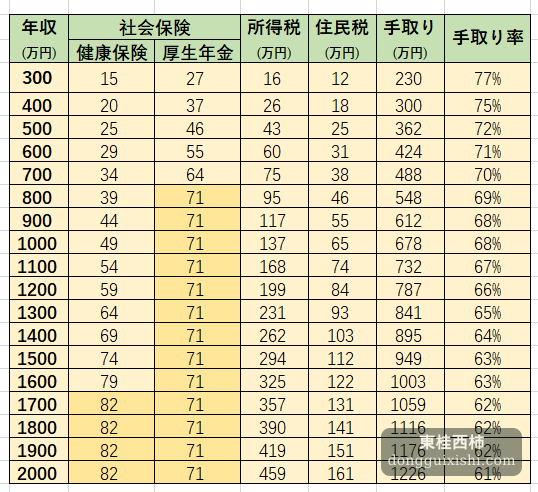
Interestingly, an annual income of 7 million yen is also roughly a dividing line between social layers. If a family has this income, it can basically get by, but it may still be living paycheck to paycheck and find it hard to handle buying a home or paying for a child’s university education in the future.
Looking at the chart again, households with annual incomes between 7 million and 9 million yen may work hard their whole lives and still end up with little left. If the income reaches 9 million yen, life may be easier for the child. Four years of undergraduate education may require preparing 10 million yen or more.
I have heard that public universities in Japan are relatively few, perhaps under 20% of the total, while private universities are expensive. As a result, many students rely on loans and spend the first few years after graduation repaying them. This is truly a vicious cycle. Perhaps it is also one reason many families do not want children. Without children, this level of income can still allow a more relaxed life. With children, the situation becomes completely different.
Not Looking Away
We look at data not to create more anxiety, but to better plan our own course, especially because we are foreigners.
Do I feel anxious living in Japan?
Yes. But my anxiety does not stop me from doing things or working. It mainly affects travel and eating out. I do not have much interest in sightseeing, and I try not to search for restaurants just to satisfy my appetite.
If life is hard, why stay in Japan? In reality, it is hard everywhere. My life in China was also hard and anxious. I was anxious about unstable policies, tired of constant changes, and exhausted by words and actions not matching. It was not only hard; from time to time, things were “forced equals voluntary.”
I have seriously thought about it. Just as many parts of life require calculating the optimal solution and best route, for someone like me, remaining single may actually be the optimal solution, and in some ways it may even beat staying in Japan.
Live Well for Yourself
Japan gives me a mixed feeling: in some ways it is twenty or thirty years ahead, while in other ways it recalls twenty or thirty years ago.
For example, many detached houses here, whether in cities or rural areas, are crowded closely together. If this were in China, neighbors might easily get into major conflicts before such houses could even be built.
At the same time, flowers, trees, and animals live freely. Flowers bloom and wither naturally; fruit ripens naturally; crows and pigeons are not afraid of people.
If we lower material desires a little, simplify life a little, and create more sources of income, I think we can all live a bit more happily. “For your own good, so you are blocked.” “For your sake, so you are isolated.” Giant babies may never be able to leave those two breasts. Great doctors often understand terrible diseases, but they do not become terrible people simply because they understand chronic illness.
Understanding both the good and the bad allows us to become better versions of ourselves. Life is so short. For yourself and for your family, live well.