
Works
Stock Mind - Japanese Stock Trading Assistant
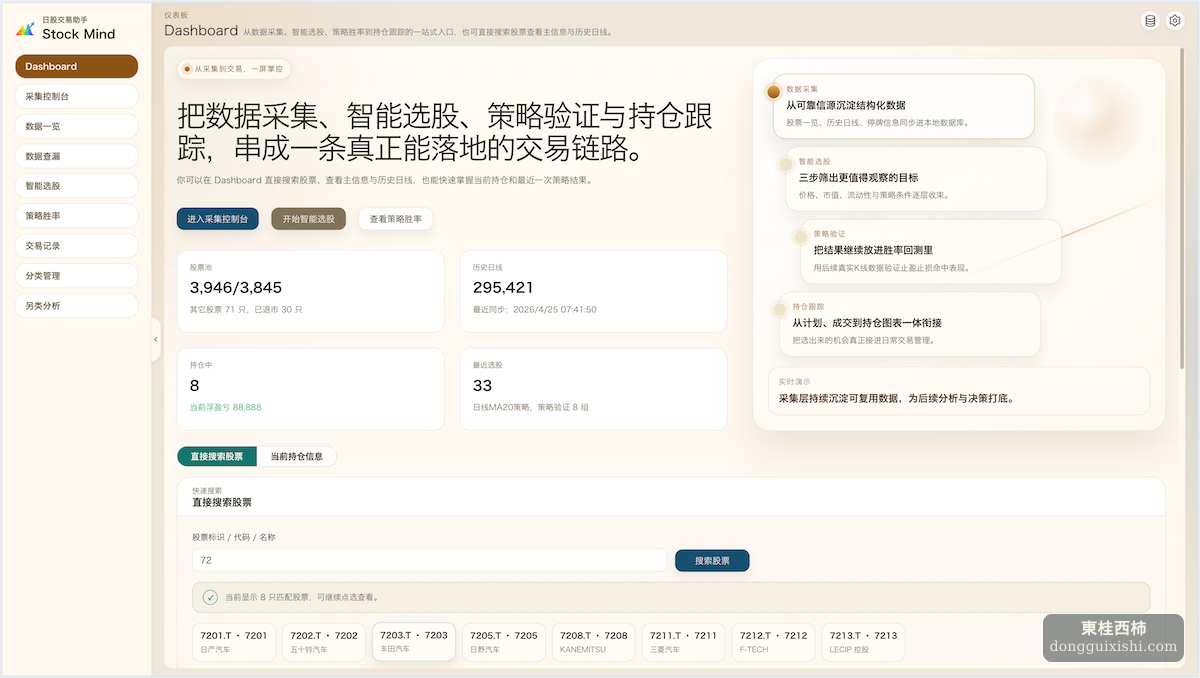
Stock Mind is an all-in-one browser extension for researching Japanese stocks, covering data collection, intelligent stock screening, strategy win-rate testing, trade records, and current position tracking.
Overview
Stock Mind is an all-in-one browser extension built for Japanese stock research. It covers data collection, intelligent stock screening, strategy win-rate testing, trade records, and current position tracking, turning data collection, stock selection, strategy validation, and portfolio follow-up into one connected workflow.
It does more than surface a list of candidate stocks. It also shows the screening logic behind the result, including enhanced-configuration exclusion details, general-filter exclusion details, selection snapshots, saved parameters, and review records. The strategy testing module can calculate minimum required capital and simulated profit or loss based on Japanese trading unit rules, making the result closer to real execution conditions.
If you want to move Japanese stock research from scattered manual work into a system that can be reviewed and improved over time, Stock Mind is designed to be a practical workbench.
The Problem It Solves
When researching Japanese stocks, the hardest part is often not the lack of ideas. It is that the whole process is too fragmented.
You may look for stock lists on one page, fetch historical daily data somewhere else, then manually record parameters after finding a group of candidates. After you finally test a strategy’s win rate, real trading introduces another set of disconnected work: position tracking, take-profit and stop-loss levels, unrealized profit and loss, and follow-up notes. Research and execution can feel separated by a pane of glass.
That is exactly the gap Stock Mind is meant to close.
It is not just a plugin that displays data, and it is not just a tool that runs a strategy. It is a workbench built around a closed-loop Japanese stock research process:
from data collection to intelligent stock screening, strategy win-rate testing, and trade and position tracking, everything sits inside one system. Research results can naturally move toward execution, and execution results can feed back into the research process.
Who Is Stock Mind For?
Stock Mind is a good fit if any of the following sounds familiar:
- You focus on Japanese stocks and want a research workbench that feels smooth to use
- You already screen stocks, but the workflow still depends on Excel and manual sorting
- You can design strategy ideas, but validation and tracking are not yet systematic
- You want research, testing, trading, and review to live inside one closed loop
- You want to turn your own research method into a repeatable process over time
Key Features
A Tool Built Around the Real Japanese Stock Research Workflow
The core value of Stock Mind is not that it has many separate features. It is that those features are connected.
You can start by syncing stock master data and historical daily prices in the data collection console, so the research base stays consistent. Then you can move into intelligent screening and filter by price range, market capitalization, liquidity level, and strategy conditions. The selected result can be saved directly as a sample for strategy win-rate testing instead of being exported and reorganized by hand. In the strategy testing module, you can review the original screening snapshot, parameters, enhanced configuration, and filtering results. Finally, the trade records module continues the workflow by tracking entries, exits, remaining positions, unrealized profit and loss, and signals.
What does this mean in practice?
It means you no longer need to jump back and forth between Excel files, websites, screenshots, and note-taking apps.
Your research workflow has a chance to become a complete system for the first time.
Optimized for the Japanese Stock Market
Many tools appear to support stock analysis, but anyone who has seriously researched Japanese stocks knows that the Japanese market has many details that cannot be solved by simply translating a US-stock tool.
Stock Mind is designed around Japanese stock research from the start, for example:
- It uses Japanese stock master data and historical daily prices as the core data foundation
- Screening can consider liquidity level, stock price, market capitalization, and industry distribution
- Strategy validation supports both Japanese 100-share unit trading and odd-lot trading
- Snapshots, screening results, and win-rate details are organized around real review habits
- For practical risk filters such as high-volume mechanical sideways movement, it provides general enhanced filtering
- Parameters, snapshots, and charts can be saved for team sharing and later review
It is not a generic stock tool. It is closer to an assistant that understands the workflow of Japanese stock research.
Intelligent Screening That Explains the Result
Many screening tools can tell you how many stocks remain, but they cannot clearly explain why one stock was kept and another was excluded.
Stock Mind pays close attention to that layer.
In intelligent screening, the result is divided into three clear steps:
- Initial filtering by price and market capitalization
- Liquidity filtering
- Strategy screening result
In the third step, you can see not only the final selected stocks, but also:
- Which strategy was executed
- Whether enhanced configuration was applied
- How many stocks were excluded by the general filter
- Which stocks each filter item excluded
- How many stocks were excluded by enhanced configuration
- Which stocks each enhanced rule excluded
This transparency matters.
The biggest risk in research is not having no result. It is getting a result that looks right while not knowing why it looks right.
Stock Mind makes strategy screening explainable and reviewable instead of leaving it as a black box.
From Strategy Idea to Win-Rate Testing in One Loop
For many people, the biggest problem with strategy testing is not the calculation itself. It is incomplete sample records.
You screen a group of stocks today and feel the result looks promising. A few days later, when you want to test it, you may no longer remember which parameters, filters, or enhanced configurations were used. All that remains is a vague impression: “I remember that result was pretty good.”
Stock Mind fills that gap.
Every time you move from intelligent screening into strategy win-rate testing, it saves the context at that moment:
- The stock selection snapshot
- Basic screening parameters
- Strategy parameters
- Enhanced configuration
- General filter configuration
When you revisit any win-rate record, you see not only the win rate itself, but also the full context behind it. That is what makes a test record genuinely useful.
More Than Win Rate: Real Execution Constraints
A high win rate does not automatically mean a strategy can be traded.
And something that can be traded is not necessarily stable enough to trade over time.
In the strategy testing module, Stock Mind does not only count which stocks rose or fell. It also brings execution-related questions into the analysis, such as required capital, minimum capital threshold, and simulated profit or loss.
For Japanese stock trading rules in particular, it supports:
- Standard unit-share trading
- Odd-lot trading
It recalculates the minimum required capital for each strategy group based on the selected configuration. As a result, win rate is no longer just a number detached from reality. It becomes closer to something that can actually be executed.
For anyone serious about systematic research, this is a key detail.
Trade Records and Current Positions Continue the Research Flow
Research and trading are disconnected in most tools.
Stock Mind is designed not to break that chain.
Once you actually start trading, the trade records module continues from the earlier research results. You can record entries, exits, remaining positions, and track:
- Latest stock price
- Unrealized profit and loss
- Realized profit and loss
- Current signal status
- Chart observations
More importantly, the system handles valuation cautiously.
For example, if the latest historical daily price has not yet been updated after an entry, it will not force an unrealized profit-and-loss calculation using stale price data. This avoids misleading account figures. Details like this show respect for real usage scenarios.
Not Just a Tool, But a Review and Sharing Platform
Stock Mind works well for individual researchers and for small teams.
It does not only let you see results. It also helps you organize them:
- Export CSV files
- Generate stock selection snapshots
- Generate analysis charts
- Keep snapshot records with parameters
- Make external presentation and internal discussion easier
You no longer need to manually stitch screenshots, tables, and explanations together.
The research process itself can become a content asset.
Collaboration Directions
For Manual Traders
-
First, you only need to provide:
- The stock price range you want to trade
- The market capitalization range you want to trade
-
Stock Mind will generate a weekly report for reference.
- Depending on market conditions, there may be no selected stocks in a given week
-
What needs to be recorded:
- If you trade any stock from the report, please help record the basic trade information:
- Entry: trade date + stock code + entry price
- Exit: trade date + stock code + exit price
For Automated Traders
-
First, you only need to provide:
- The stock price range you want to trade
- The market capitalization range you want to trade
-
Stock Mind will generate weekly automated trading data, including:
- Stock code
- Minimum total required capital
- Capital allocation per stock
- Trading quantity
- Entry price / take-profit price / stop-loss price, and related levels
Depending on market conditions, there may be no selected stocks in a given week.
-
What needs to be coordinated:
Once a strategy starts running, it is better not to interfere manually unless necessary. This makes the result more stable and easier to review later.
All of the above collaboration is free, but it requires following the agreed rules. The main goal is to work together and gradually optimize strategies that can truly make stable profits.
The value of Stock Mind is not to make decisions for you. It is to help you make decisions based on a more complete, traceable, and executable process.
In Japanese stock research, the real difference is often not one extra indicator. It is whether you have a research system that can be reused over the long term.
Stock Mind is intended to be the starting point of that system.
If you want to upgrade Japanese stock research from scattered manual work into a complete closed loop, Stock Mind is worth a serious look.