
There Is Nothing New Under the Sun. In the AI Boom, a Good Side Hustle Is Still Selling Shovels
Whenever an industry enters a major transition period, it often comes together with a broader economic downturn. Strangely enough, that is also when many people become especially eager to start a business. It is hard to explain the reason clearly, but after observing this pattern for many years, that is the situation I keep seeing.
A Story From More Than Ten Years Ago
Let me tell a story from more than a decade ago. At that time, I had a personal studio website. I had a decent number of clients, just enough work for one person to maintain, and occasionally I would ask a part-time helper to lend a hand.
One day, a client came to me and said he wanted me to help him build a movie and TV streaming website as a startup project. After talking for a while, I learned that because he knew almost nothing about technology, he had already been burned once. He had paid someone, but nothing usable came out of it. Still, he was unwilling to give up. A friend online had recommended me, so he wanted to try again.
He was a very typical example from that wave of startup enthusiasm. He had seen many people making money from video sites through traffic and thought that as long as he bought a server, deployed a streaming site, and connected an ad network, the money would start coming in while he slept. He had not really thought about technology, content, promotion, maintenance, or any of the messy work behind the scenes.
After a deeper conversation, I was already quite clear in my mind: there was a 90 percent chance this would fail. But seeing how fired up he was, I did not pour cold water on him directly. Anyone who has started a business knows this feeling. Once the idea takes hold, other people’s advice usually does not work. It may even make the person unhappy.
His situation was that the company he worked for was already doing poorly. Every day at work felt unstable. He had also saved a bit of money, so he wanted to test the waters on the side first. If it worked, he would later quit and do it full time.
I saw that he had already bought a dedicated server and left it sitting idle at a hosting provider. So I discussed it with him and said:
How about this: I will first use open-source code to set up a movie site for you. Then I will make some simple changes to the pages, such as the logo, site name, colors, and layout, and configure a few collection rules in the backend. You should get the site running first. Do not try to make it perfect from day one. If it feels promising after it is running, we can continue. If not, there is not much more I can do for you.
I remember that he reluctantly agreed. It took me about three days to deploy the site. I also made a logo based on the name he chose, set the theme color, and imported several thousand video sources before launch. Then I taught him how to handle daily maintenance. In the end, I charged him 2,000 yuan.
About one or two months later, he contacted me again. His tone was clearly different:
Why does the site have no traffic at all? This is way too tiring. It is nothing like what I imagined…
As soon as I heard that, I knew he was already starting to retreat.
In the end, he more or less said this directly:
Can you help me maintain the server too? Things like updating content regularly and cleaning dead links. I will keep trying for another year. If there is still no progress, I will stop messing with it… Otherwise the tens of thousands of yuan I already spent would feel like such a waste.
We eventually agreed that I would maintain the server and content for one year for 4,000 yuan. I will not go into the rest. I think everyone can imagine how it ended.
The Rise of the AI Boom
Over the past half year or so, I have started seeing the same phenomenon again: large numbers of people rushing in to start businesses. This is especially true for ordinary people who worked hard for years and saved 100,000, 200,000, or 300,000 yuan.
Based on my experience over the years, I dare say this: around 70 percent of these people will throw their money away, 20 percent may break even or earn a bit of hard-earned money, and at most 10 percent will truly make something work.
For friends who are hesitating over whether to start a business, I want to say something very honest: if you are starting small and really want to try, keep the idea simple at first. Do not begin by imagining that you will build a platform, chase traffic, or make money while lying down. Think of the old days: a small convenience shop on the street, phone repair, breakfast stalls. Start with something small and simple. Earn your first real money steadily, and feel what entrepreneurship actually tastes like.
Even in the AI era, the smartest and most immediately effective path is still selling shovels.
Everyone wants to “dig for gold” with AI, whether by making content, building projects, or starting side hustles. Then you can sell the “shovels” they need: stable and usable tokens, services, tools, tutorials, guided setup, and hands-on support.
These needs are real. They are practical, recurring, and often urgent. In many cases, this kind of business is more likely to survive and more likely to help you earn your first real money.
But if you choose the same path most people choose, the path of digging for gold yourself, then things become much harder.
How to Sell Shovels
First, I want to say this: start as a side hustle. Do not throw yourself into full-time entrepreneurship from the beginning. Building a business is a long process. It cannot be completed overnight. As the saying goes, good things take time.
Now back to the point. Let me briefly give two examples of how to sell AI “shovels” in the form of tokens.
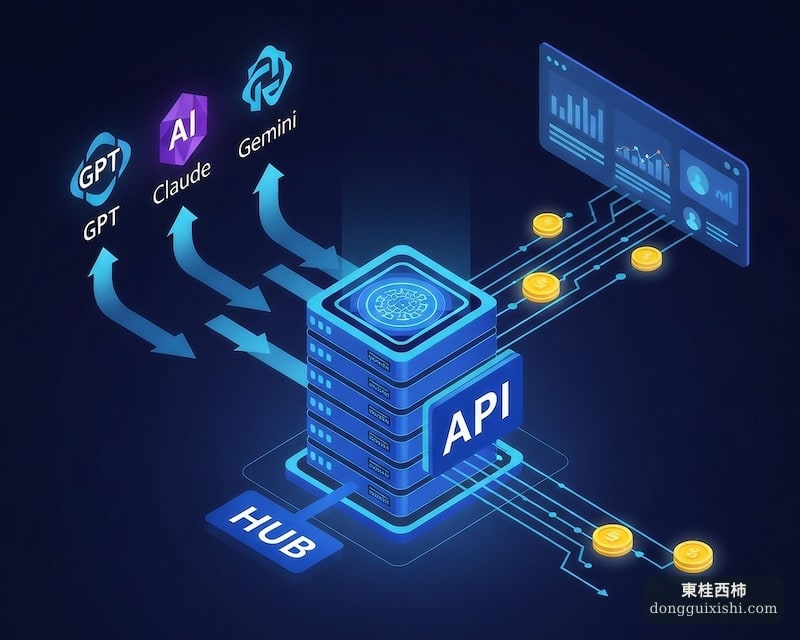
In simple terms, using New API or Sub2API to build a relay station means creating an “API aggregation and distribution management platform.”
This is usually meant to solve problems such as having too many API keys, dealing with inconsistent formats, or being unable to directly access certain large models, such as OpenAI or Claude.
What Is a Relay Station?
Imagine you have many different supermarket gift cards: an OpenAI key, an Anthropic key, a Google Gemini key. Every time you go shopping, you have to pull out the correct card.
A relay station works like a universal wallet:
- You put all your gift cards, meaning different model API keys, into it.
- The relay station gives you one “master card,” meaning a new API key.
- From then on, you only need to use that master card to call all the model resources inside your wallet from any client that supports a standard format.
Relay Station Solutions
Why is this a good side-hustle entry point?
- Low barrier to entry: if you can handle basic Docker deployment, you do not even need a deep programming background.
- Real demand: many users need models but cannot deal with overseas cards or complicated API interfaces. What you provide is infrastructure. What you earn is the “convenience fee.”
- High flexibility: you can run it as a private small-studio service, or turn it into a small aggregation platform for developers.
1. New API: Your Central Dispatch Room
New API is currently one of the standard choices for large-model relay stations. It is a fork of the well-known One API project.
- Universal aggregation: it automatically converts OpenAI, Claude, Gemini, DeepSeek, and even Chinese models such as Wenxin, Tongyi, and Hunyuan into a unified OpenAI-compatible format.
- Financial dashboard: who used how much quota, how much remains, and detailed billing records are all clear at a glance.
- Permission management: it supports creating thousands of sub-keys, each with independent rate limits and quota limits.
- Commercial readiness: built-in features such as announcements, referrals, and top-ups make it a mature SaaS prototype from the start.
Quick start path:
-
Prepare a VPS that can access the global internet. An overseas VPS is recommended.
-
Deploy New API with Docker in one command.
docker run --name new-api -d --restart always \ -p 3000:3000 \ -e TZ=Asia/Shanghai \ -v ./data:/data \ calciumion/new-api:latest -
Log in to the admin panel and add your upstream model keys, such as OpenAI or Claude.
-
Create an API key and test whether the endpoint works.
-
Use it together with NextChat or LobeChat as the frontend.
2. Sub2API: Your Subscription Converter
If New API is the backend, then Sub2API is a tool that makes your service easier to use. It can format and convert complex API nodes so users can subscribe to your model service as conveniently as subscribing to a traffic package.
- Function: it focuses more on formatting different API subscription addresses.
- Scenario: in certain distribution scenarios, it converts complex backend API nodes into frontend-friendly subscription links.
Quick start path:
-
Prepare a VPS that can access the target websites.
-
Obtain the account Session or Token, usually from browser cookies.
curl -sSL https://raw.githubusercontent.com/Wei-Shaw/sub2api/main/deploy/docker-deploy.sh | bash docker compose up -d -
Deploy Sub2API, either with Node or Docker.
-
Start the service and generate the interface address.
-
Again, connect it to NextChat or LobeChat for use.
Sub2API is better suited to “subscription sharing” scenarios, such as multiple people sharing one Claude subscription service. New API is better suited to aggregating official API keys. The two can also be combined, with New API as the upstream and Sub2API connected afterward.
When everyone is rushing to start a business, I think the most reliable path is to focus on serving entrepreneurs. The key is to survive first. Once the tide goes out, you’ll be in a much stronger position to pursue bigger ideas—because you’ll have more capital, and most of your competitors will have already disappeared.